
What happens when you need to change your VCola Application?
One of the questions we hear from enterprise buyers is some version of:
OK, the initial generation sounds interesting but what happens when you need to change your application? Real payroll software evolves constantly.
It's a fair question and one of the key goals that we set ourselves was the ability to automate the upgrade of production applications that have been generated by the VCola platform. We recently had the opportunity to test out our approach in practice.
Production Upgrades on the VCola Platform
We just shipped a production upgrade to the VCola HCM, the Irish payroll system we built and now run on our own production platform. The upgrade touched several meaningful areas at once:
- Configuration management
- Auto-enrolment integration for myFutureFund, the new Irish State sponsored retirement saving scheme
- Bank payment workflow with Revolut
- Some underlying data model cleanup
What We Changed
Consolidated ROS and NAERSA Configuration
We previously maintained two separate configuration stores - one for Revenue Online Service settings and one for the MyFutureFund (NAERSA) auto-enrolment integration. These have been merged into a single configuration record, with a cleaner distinction between sandbox and production environments. This unified approach simplifies how we manage the sandbox and production targets where ROS and MyFutureFund integrations operate in tandem.
Streamlined auto-enrolment (AEPN) handling
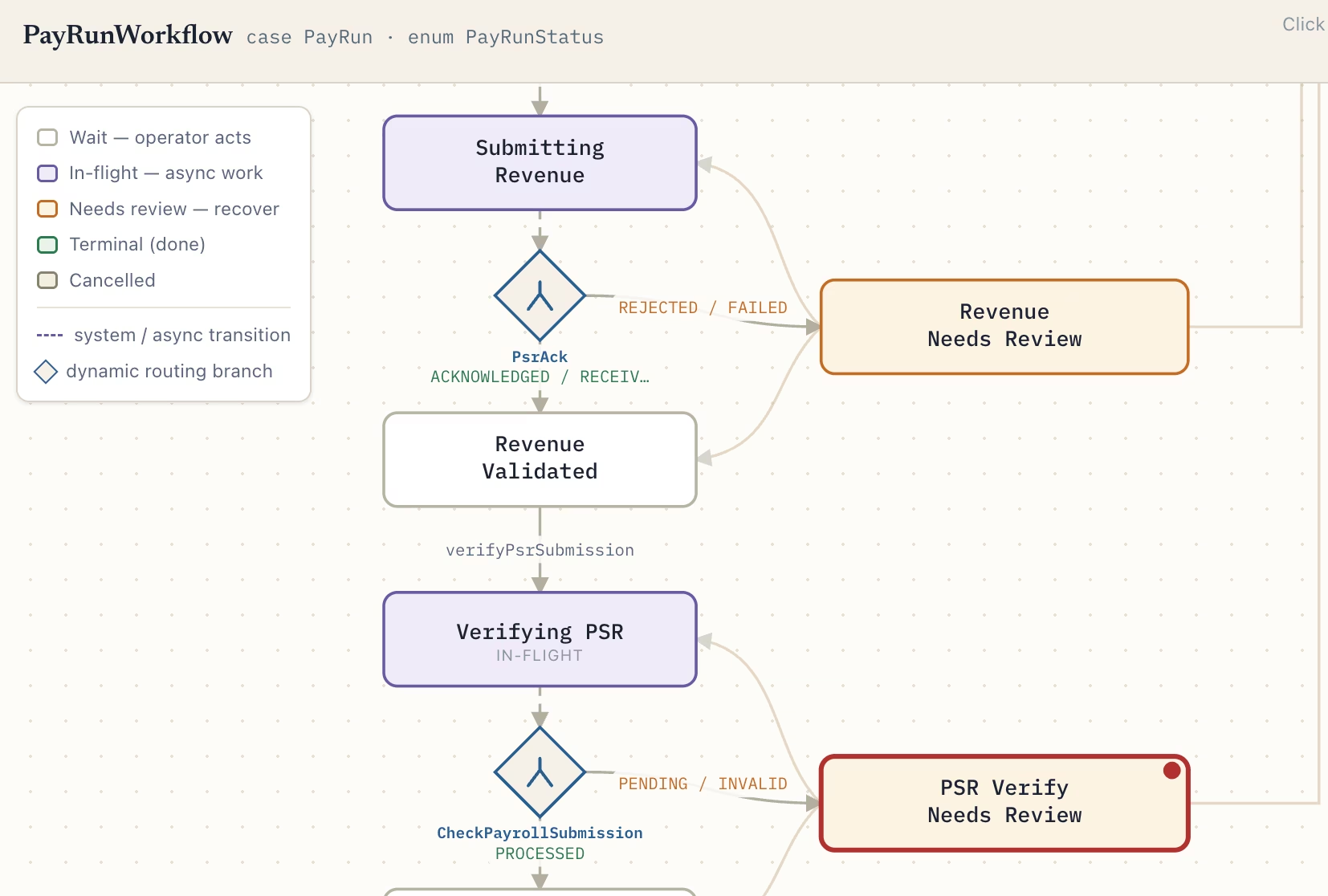
The previous flow required a dedicated operator review step to confirm AEPN contribution rates before payroll calculation could begin. We've removed that gate. Contribution rates are now resolved automatically from the NAERSA feed data during calculation, using the employee's PPSN and employment ID. One less manual step in each pay run cycle.
Simplified bank payment flow
Previously, the payroll workflow included an automated step that waited for the bank to return a formal payment confirmation file. In practice, using Revolut Business as our banking provider, this added complexity without adding much value. We've replaced it with a straightforward operator confirmation step: the payment goes out via Revolut CSV export, and a payroll administrator confirms receipt. Less automation theatre, more clarity.
Cleaner employee data model
We moved the employee PPSN (the Irish tax identification number) to sit directly on the employee profile rather than buried inside the tax profile. This sounds like housekeeping, but it matters: the PPSN is increasingly used as a lookup key across payroll, auto-enrolment and RPN data and it belongs where the employee record lives.
What The VCola Payroll Application Upgrade Process Actually Looks Like
The migration ran as a single database transaction, if anything failed, the whole transaction rolled back cleanly. The database was snapshotted and the application was taken offline briefly beforehand (a standard precaution for schema-level changes), the upgrade ran and the system came back up with the new configuration intact.
The migration process itself covering : data model changes, configuration consolidation, workflow state remapping and table cleanup took approx 2 mins to run. The accompanying commentary explaining each decision is almost as long as the code.
Why This Matters For Generated Software
A common assumption is that AI-generated software is brittle, fine for a greenfield demo, not suitable for a system that needs to change over time. Our experience is the opposite. Because VCola applications are generated from formal domain specifications, changes start with the specification. The domain model is updated first, the invariants and lifecycle rules are restated and the generated artefacts (including migration logic) follow from that. The upgrade you're reading about wasn't written by hand from scratch; it was the output of an updated spec.
That said, we don't want to overstate it. Production payroll upgrades require care regardless of how the software was built. The discipline of writing explicit migration commentary, handling in-flight workflow states, and testing against real data - that's still on the team. What changes is how much of the underlying heavy lifting was already done before anyone opened a text editor.
What's Next?
The changes in this release lay groundwork for many future enhancements: expenses, managing contractors, time off management etc. Stay tuned.
If you're evaluating payroll platforms and want to understand how the VCola generation model handles ongoing change, we're happy to walk through it in more detail.
We've opened our Early Adopter Program and have a few spots left in the current cohort. Sign up here