
At VCola we believe much of the debate regarding AI’s impact on enterprise software - like Lionel Messi’s penalty against Austria in the group stages of the FIFA World Cup - is wide of the mark. Pundits and industry insiders simply aren’t thinking big enough.
AI can do more than simply optimize existing processes. It has the power to fundamentally redefine how business software is developed, deployed, and utilized, completely transforming how business is carried out as a consequence.
Capturing Intent: the new specification-driven architecture
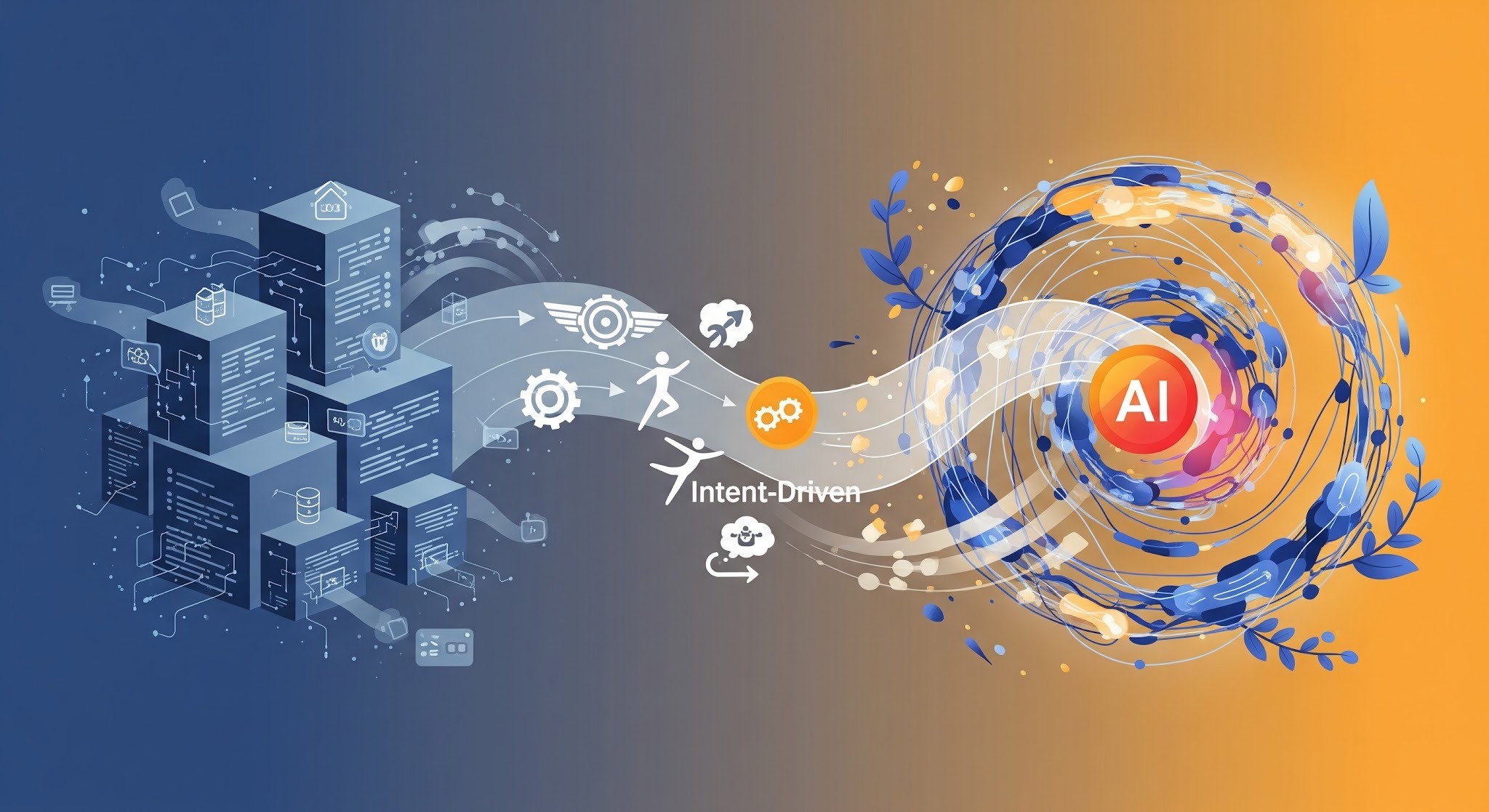
It starts in the enterprise application development process by capturing business intent in a detailed, living specification that underpins the evolving application. This approach provides the foundation for next-generation architectures that move beyond traditional software limitations, delivering agentic enterprise applications that act as dynamic partners, enabling organizations to respond to change intuitively and rapidly, by:
- Providing a living organic source of truth, maintaining a continuous link between business intent and system functionality.
- Democratizing change, enabling subject matter experts to take responsibility for updating enterprise applications.
- Shifting to an objective-driven, natural language agentic UX, replacing rigid transactional UIs.
- Accelerating system implementation and agility, reducing configuration time and consulting costs typically associated with ERP deployments.
- Eliminating organizational inertia, allowing organizations to move at speed rather than being constrained by static software models.
Democratizing Change
In traditional SaaS and on-premise ERP systems, change is slow and prohibitively expensive. Whether adapting to new regulations or shifting market conditions, organizations frequently face a choice between costly consultants and time consuming in-house customizations. Often they opt to do nothing. This inertia has potential for even greater cost from lost opportunity, and fragmented data as users default to adhoc workarounds which decay the integrity of the core System of Record.
Spectra: The Living Specification
VCola eliminates this friction, democratizing application updates. In a VCola Spectra-driven environment, the specification is an organic, evolving source of truth. Unlike traditional requirement documents that become obsolete immediately after development, Spectra maintains a direct link between business intent and functionality.
Subject matter experts can now describe necessary changes directly to VCola Studio. These inputs automatically update the application's "Spectra" specification, seamlessly modifying functionality without requiring deep technical intervention. This ensures the application always remains aligned with current business objectives.
Objective-driven Agentic UX
This architectural shift enables a move from transactional to objective-driven user experiences. Traditional UIs often burden users with complex menus and rigid sequences. VCola's Agentic Interfaces, however, understand the context and requirements of a task, fundamentally changing how business applications are used. No longer tied to rigid transactional templates, it allows users to interact with applications using natural language to carry out truly valuable tasks like: “Help me close my financial quarter”, “Help me run my payroll”, or “Help me analyse the impact of Sales Compensation changes”, for example.
Because of the Spectra specification, your system possesses a holistic understanding of:
- The detailed business intent of the application.
- The exact implementation requirements (automatically generated).
- The underlying data structures and security protocols.
Accelerated Implementation and Agility
Beyond operational flexibility, this paradigm significantly reduces implementation costs. In traditional ERP deployments, consultants spend months configuring systems and loading data. An agentic application built on Spectra is "self-aware"—it can guide users through the implementation process, identifying exactly what data is needed and when.
A Fundamental Shift in Enterprise Agility
The transition to specification-driven applications represents a break from the static software models of the past. By shifting complexity from the user interface to an AI-driven architecture, VCola removes the friction that has historically hindered enterprise agility. The result is a dynamic partnership between business intent and software execution, enabling organizations to move at the speed of their ideas.